
I Built Something!
How to Make AI Sound Like You

I usually write about the insides of the LLM, the part that no one quite understands just yet. Today, I’m excited to announce something more focussed on the output of the LLM, although there was a lot of mechanistic interpretability involved with making it.
Everything the AI writes sounds the same. Your writing doesn’t have to.
You’ve noticed it. Ask ChatGPT or Claude to draft something in your voice and you get back the same competent, faintly plastic prose everyone else gets — the tidy tricolons, the “it’s not just X, it’s Y,” the em-dashes deployed like confetti. It’s fluent. It’s forgettable. And it is quietly flattening the way a whole lot of people write.
The strange part is that this is a solvable problem, and the solution isn’t a bigger model. It’s a better description of you.
Your voice is measurable
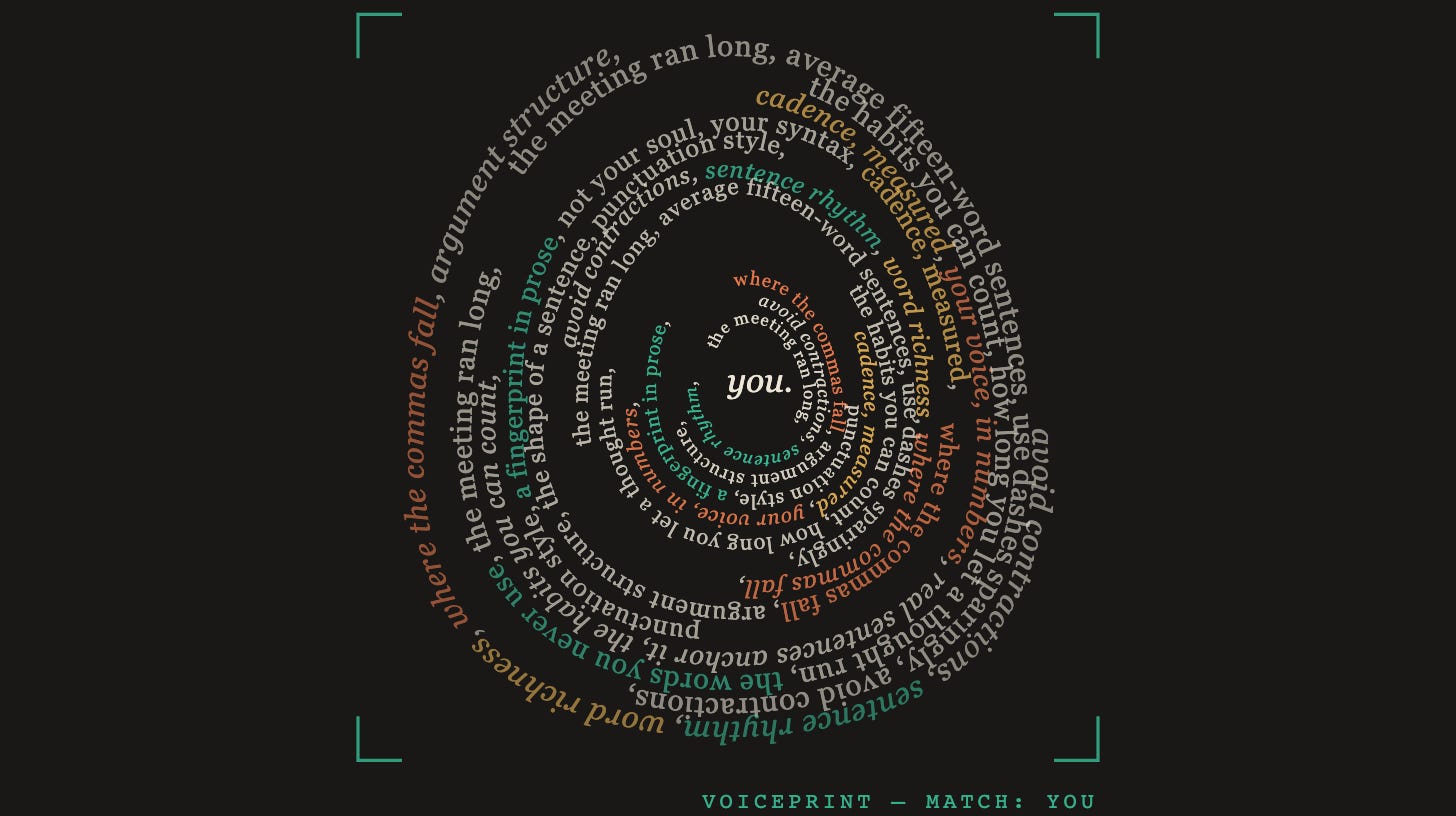
Stylometrists have known for a century that prose carries a fingerprint. Not the ideas — the mechanics. How long your sentences run, and how much that length varies. Whether you reach for the em-dash or the semicolon or neither. Your contraction rate. How rich your vocabulary is before it starts repeating. Whether you argue by contrast (”not this, but that”) or accumulation. These are the features that convicted the Unabomber and unmasked the author of Primary Colors. They are stable, they are individual, and — this is the useful part — they are countable.
Which means the thing that makes your writing yours can be handed to a language model as a specification. Not “write like me” (it has no idea what that means), but “average 17 words a sentence, vary widely, one em-dash every few sentences, formal register, no hype-filler” — plus a few of your actual sentences as reference. Suddenly the output stops sounding like the assistant and starts sounding like a person.
So I built the tool I wanted
YourVoiceCraft takes a sample of your writing and runs a stylometric analysis on it. Locally. Nothing is shipped off to an AI service; the measurement happens on the server and your prose stays yours.
What you get back is a Voice Report: a plain-English read on what makes your writing distinctive, plotted against typical, academic, and literary prose — your sentence rhythm, your punctuation signatures, your most characteristic vocabulary, and the places your voice tends to break. And at the center of it, the actual payload: a personalized copy-paste prompt, built from your fingerprint and anchored with your own best sentences, that you drop into ChatGPT or Claude to make it write like you instead of like itself.
It’s free. It takes about a minute.
Prompt limitations
First: a prompt gets you some of the way, not all of it. In my own testing, a well-calibrated prompt roughly doubles how faithfully a model reproduces a distinctive voice, but a small model fine-tuned on your corpus does meaningfully better still. So the prompt is the free, zero-infrastructure product; a private, secure hardware voice model is the premium version, for people who want the last mile and want to own it.
Second: the reason your own sentences go into the prompt isn’t a trick. It’s the single most effective, and cheapest, lever there is. The tool’s job is picking the right sentences and pairing them with the measurements. You could do it by hand. Most people won’t, and wouldn’t know which lines to choose.
And, because it’s fun
There’s a demo where you paste any text and have it rewritten in a pre-trained voice — Dickens, Twain, Poe, Dickinson, Seneca, Marcus Aurelius — on a fine-tuned local model. Feed it “the meeting ran long and everyone was tired” and Poe returns a funereal procession through the chambers of the brain; Twain drawls it out with Jim on the road home; Dickinson hands it back as four lines of dashed verse. It’s a toy, but it’s the same machinery underneath — proof that a model can wear a specific voice rather than the house style.
That part’s live now too. Go break it. And it’s not limited to dead authors: if you sign up, you can give it a few thousand words of your writing and it will train a model on you.
Where this goes next
The demo and the report are two ends of one pipeline: measure a voice, then teach a small model to wear it. The paid product is the middle.
- Your own private voice model. Not a prompt you paste into someone else’s assistant, but a model fine-tuned on your corpus that both rewrites and drafts in your voice — and runs on our hardware, not OpenAI’s. The mechanic is deliberately simple: you get a private upload link, you drop your writing there, and when the model finishes training that same link becomes your page. Your prose never touches a third-party API, start to finish.
- Brand and team voice. The same thing, shared: one model trained on a company’s published writing, so a whole comms team can write on-voice from day one — and legal doesn’t have to bless pasting sensitive drafts into a public chatbot. This is the version regulated industries actually need.
- A voice you can measure against. Because the fingerprint is countable, the tool can score any draft for how much it sounds like you and flag the passages that don’t — useful the moment someone writes as you and has to prove it.
None of that needs a bigger model. It needs a better description of a person, and a small model willing to wear it.
What it costs
The Voice Report, the prompt, and the demo are free — that’s the whole front door. A private voice model is a monthly subscription: your own model, unlimited rewrites, draft-in-voice, and a consistency check. Brand and team plans will add shared voice, seats, and the privacy guarantee that makes the whole thing viable inside a regulated company. If you need it on hardware you physically control, that will exist too.
Try it → yourvoicecraft.ai
Bring your own prose. Find out what your fingerprint actually is. And then make the machines write in it, instead of the other way around.